What the Fed's first hike in three years means for investors
Key takeaways
- The Federal Reserve raised the fed funds target range by 25 basis points, or 0.25%, to 3.75%-4.00%, as widely expected.
- Policymakers expect one more rate hike this year, but they remain divided over whether further tightening will be needed in 2027.
- Markets initially interpreted the Fed's message as modestly more hawkish than expected. Equities declined and bond yields rose following the announcement, though stocks later rebounded.
- We believe equity markets can continue to perform well in a higher-yield environment, particularly if economic growth remains resilient and corporate earnings continue to rise at a solid double-digit pace.
- Higher short-term bond yields have widened their potential income advantage over cash. This may provide an opportunity to generate more income on excess cash while taking on only modest additional interest-rate risk.
Fed hikes and shifts modestly more hawkish
As widely expected, the Federal Reserve raised the fed funds target range to 3.75%-4.00%, marking its first rate hike in three years. Because the decision was largely priced into markets, investors focused more closely on the Fed's updated economic projections and Chair Kevin Warsh's tone in the press conference.
The updated projections pointed to a more inflation-focused Fed. Policymakers raised their inflation forecasts and penciled in another expected rate hike before year-end. Beyond this year, however, the outlook is less settled. Eight of the 18 officials projected one more rate increase in 2027, while the remaining respondents expect no change or a cut. This distribution highlights the lack of consensus on whether further tightening will be needed next year.
The longer-run projection for the fed funds rate also moved modestly higher. This suggests that policymakers are gradually raising their estimate of a neutral policy rate, which neither stimulates nor restrains the economy. If correct, this would imply that current monetary policy may be less restrictive and interest rates may ultimately settle slightly higher than previously thought.
Chair Warsh reinforced the modestly hawkish message by emphasizing persistent underlying inflation pressures. His characterization of the rate increase as “removing a dose of policy accommodation” was particularly notable. In our view, the comment suggests that he does not yet view current policy as meaningfully restrictive and may therefore see room for additional rate increases if inflation remains elevated.
Overall, we believe that the Fed is recalibrating policy to return inflation toward target more quickly. Gradual, measured adjustments amid resilient but steady growth should be less disruptive to markets than rapid tightening intended to restrain an overheating economy.
Economic and labor-market resilience give the Fed room to focus on inflation
The Fed's updated projections also reflected a somewhat stronger economic backdrop. Policymakers raised their near-term growth outlook, which remains above its estimated longer-term trend, and upgraded their assessment of the labor market. Together, these revisions suggest that policymakers believe the economy can absorb somewhat tighter monetary policy without a material deterioration in employment.
Markets continue to price in a somewhat higher path for the fed funds rate than reflected in the Fed's own projections. This gap highlights some uncertainty around the policy outlook, shown below:
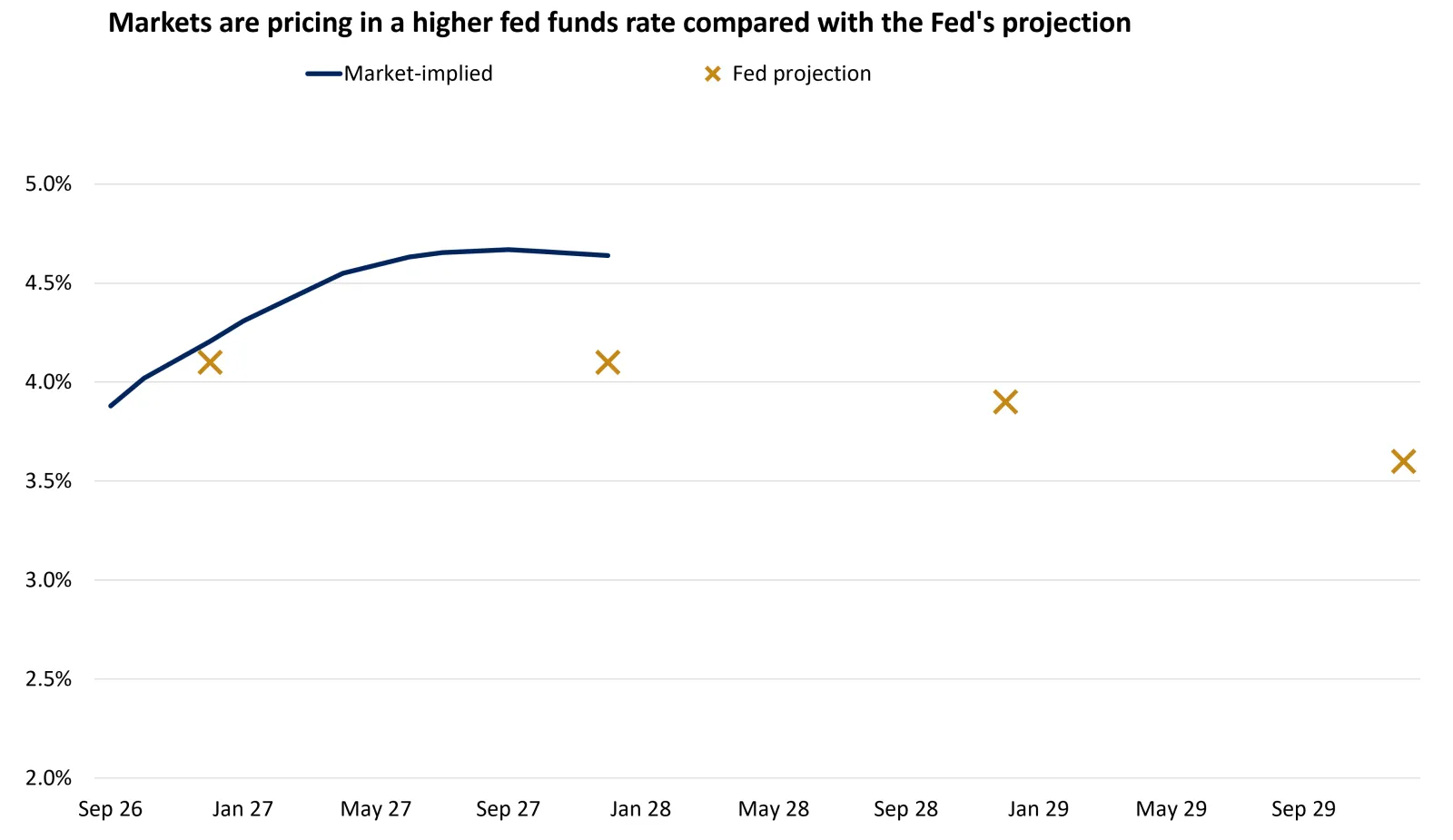
The chart shows that markets are pricing a higher fed funds rate compared with the Fed's projection.
The chart shows that markets are pricing a higher fed funds rate compared with the Fed's projection.
The two-year Treasury yield, which is particularly sensitive to changes in policy-rate expectations, rose by about 10 basis points (0.10%) after the announcement. The move indicates that bond markets viewed the announcement as modestly more hawkish than expected.
We think the Fed's decision and projections reinforce its commitment to restoring price stability. That should help preserve the central bank's inflation-fighting credibility. Market-based measures of inflation expectations, which are a key component of nominal bond yields, appear to support this view. Breakeven inflation rates in Treasury Inflation Protected Securities (TIPS) markets declined by approximately 5-10 basis points (0.05%-0.10%) this week, shown below:
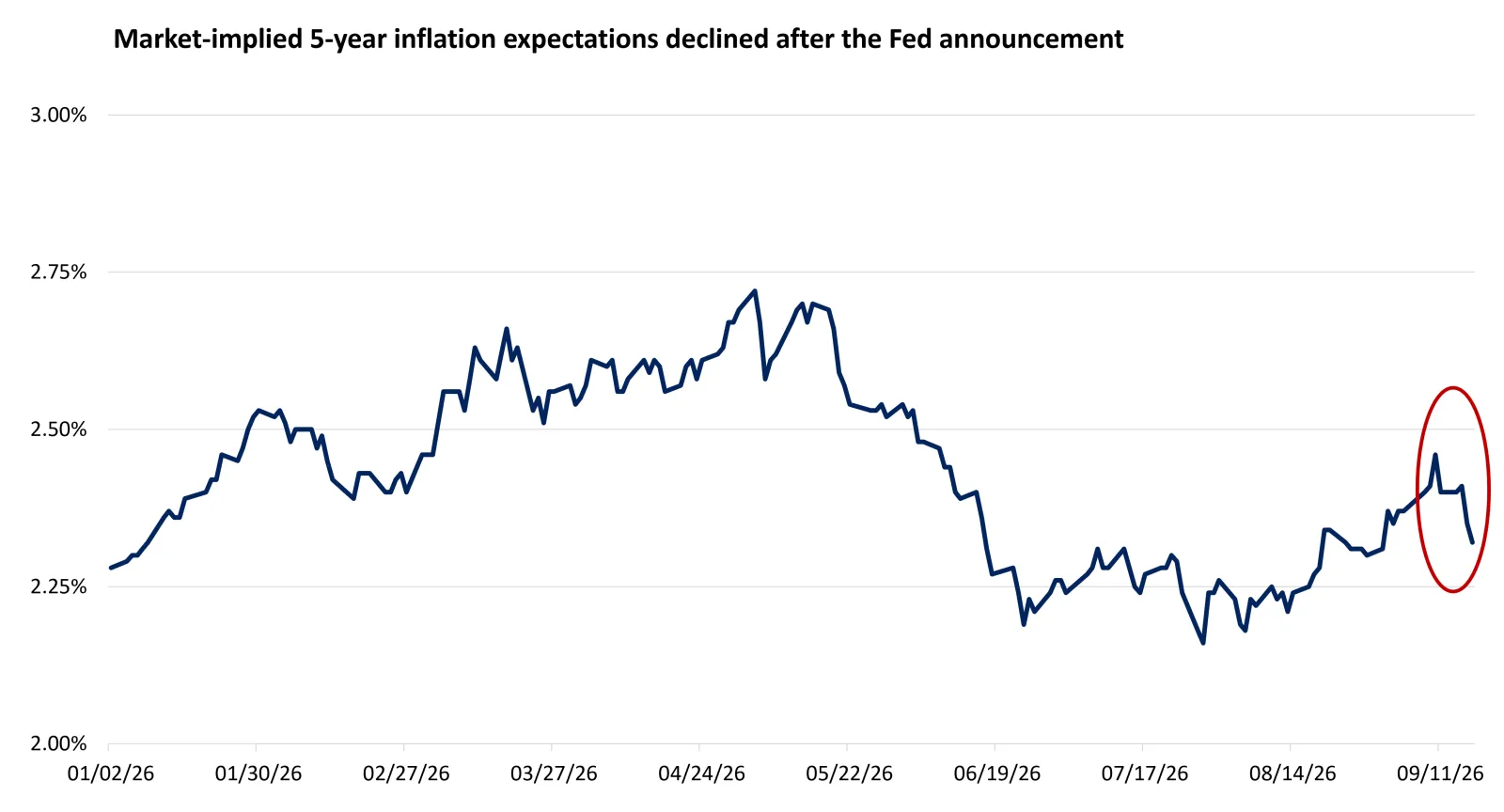
The chart shows that market-implied inflation expectations declined after the Fed's announcement this week.
The chart shows that market-implied inflation expectations declined after the Fed's announcement this week.
Continued earnings strength can support equity markets
If the Fed ultimately delivers two or three rate increases during this phase, we believe markets would largely view these moves as a midcycle adjustment rather than the beginning of a renewed and prolonged tightening cycle. Borrowing costs could rise, particularly at the short end of the curve, but we would not expect this to derail broader economic growth or the corporate earnings outlook.
Resilient consumer spending and continued earnings growth can help offset higher interest rates, particularly if inflation gradually moves back toward the Fed's 2% target. Equity valuations have pulled back recently as bond yields have risen, but strong earnings growth has offset much of that effect and helped support market performance.
Earnings growth is expected to moderate from the second quarter's exceptionally strong pace but remain near the 20% range for both the S&P 500 and U.S. mid-cap stocks over the quarters ahead, shown below:
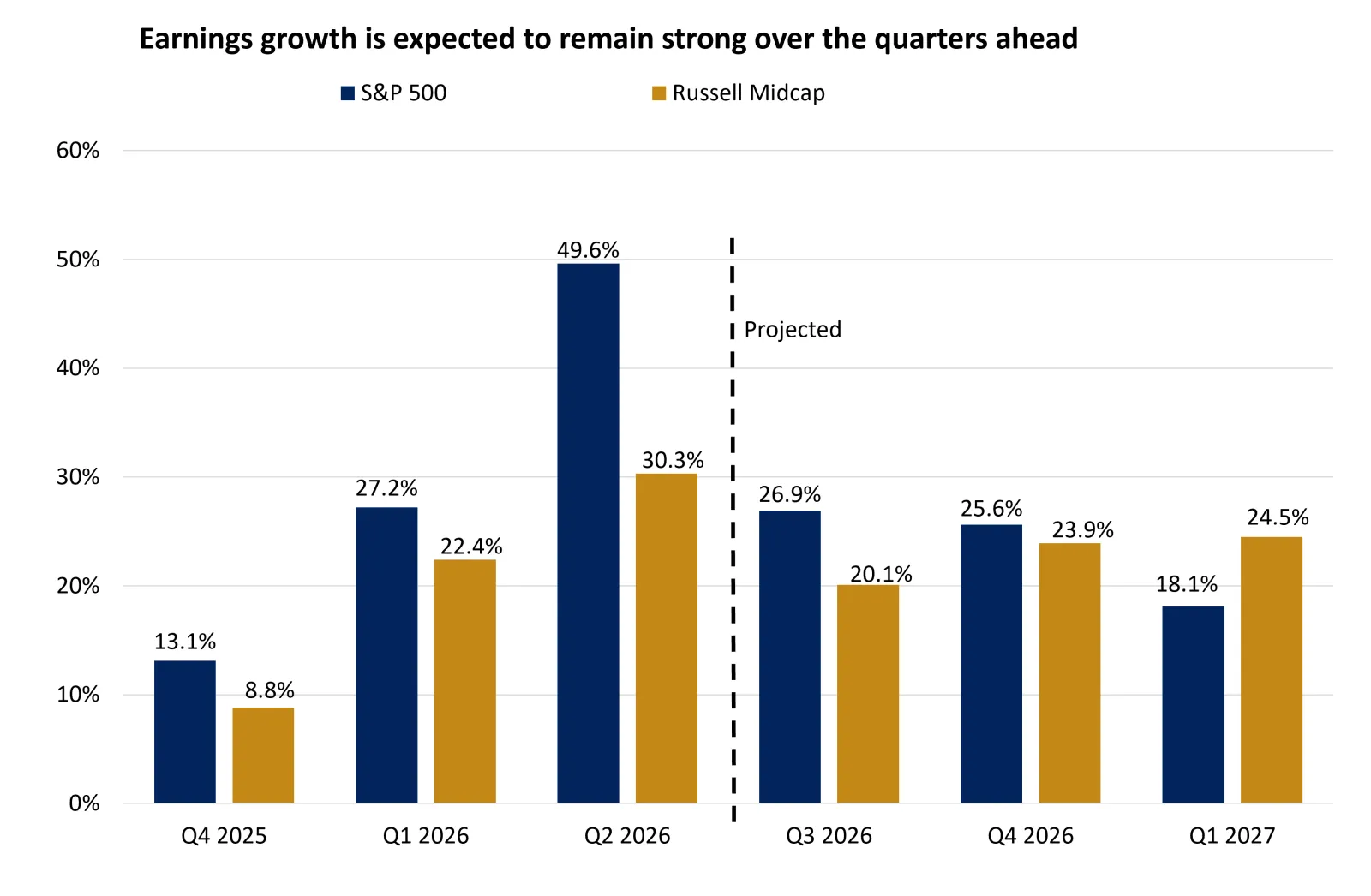
The chart shows that large- and mid-cap earnings growth is expected to remain near the 20% range over the quarters ahead. Past performance does not guarantee future results. An index is unmanaged, cannot be invested into directly and is not meant to depict an actual investment.
The chart shows that large- and mid-cap earnings growth is expected to remain near the 20% range over the quarters ahead. Past performance does not guarantee future results. An index is unmanaged, cannot be invested into directly and is not meant to depict an actual investment.
Despite elevated oil prices and inflation, August retail sales exceeded expectations, reflecting continued household spending. For investors, resilient consumption and broad-based earnings growth should help support stronger performance across a wider range of sectors and companies. We believe such a broadening could help make the market's advance more durable if it's less reliant on a small group of mega-cap companies.
Short-term bonds now offer a wider yield advantage over cash
Short-term bond yields have risen from recent lows, reflecting expectations for additional Fed rate hikes. As a result, short-term bonds now offer a wider yield advantage over cash, shown below:
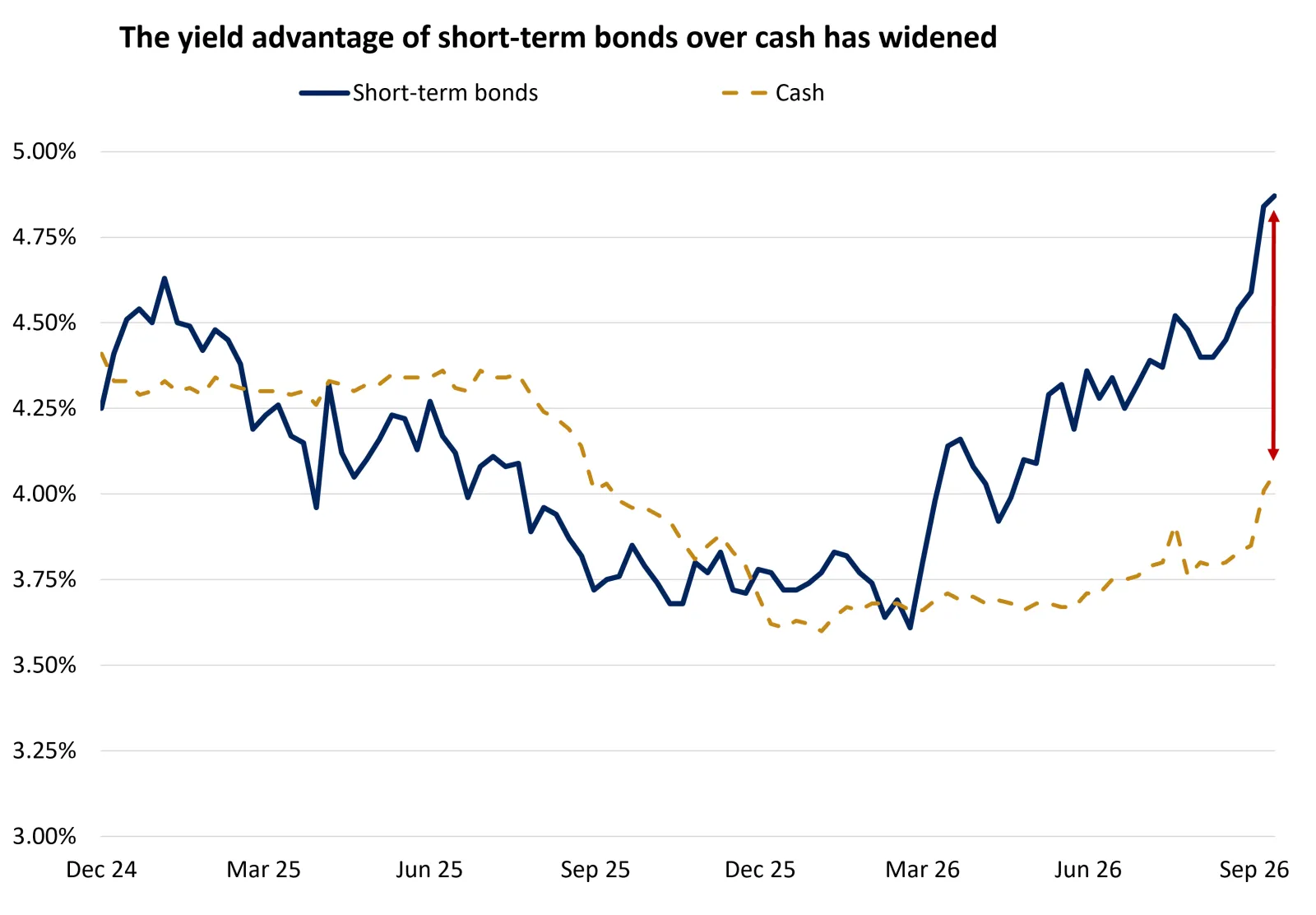
The chart shows that the yield advantage of short-term bonds over cash has widened. Short-term bonds are represented by the yield to worst of the Bloomberg 1-5 year U.S. Government/Credit Index. Cash is represented by the yield to worst of the Bloomberg U.S. Treasury Bellwethers 3 month Index. Past performance does not guarantee future results. An index is unmanaged, cannot be invested into directly and is not meant to depict an actual investment.
The chart shows that the yield advantage of short-term bonds over cash has widened. Short-term bonds are represented by the yield to worst of the Bloomberg 1-5 year U.S. Government/Credit Index. Cash is represented by the yield to worst of the Bloomberg U.S. Treasury Bellwethers 3 month Index. Past performance does not guarantee future results. An index is unmanaged, cannot be invested into directly and is not meant to depict an actual investment.
Importantly, short-term bonds are not the same as cash. Their prices can fluctuate as interest rates and credit conditions change. However, because of their shorter maturities, they are generally less sensitive to interest-rate movements than intermediate- and long-term bonds.
We believe cash plays an important role in portfolios, providing funds for unexpected expenses, short-term savings goals, and everyday spending. However, holding more cash than is needed can reduce long-term return potential. After establishing an appropriate cash reserve, consider gradually reinvesting excess cash.
Short-term fixed income — whether through bond funds, ETFs, individual bonds or CDs — may offer additional income while only modestly extending duration. We believe short-term bonds can therefore provide a middle ground between the stability of cash and the higher income potential, but greater interest-rate sensitivity, of longer-term bonds. In a higher interest rate environment, that balance may be especially attractive for investors seeking income while maintaining flexibility. Be sure to evaluate these opportunities in the context of your financial goals, risk tolerance, liquidity needs and time horizon.
Bottom line
We recommend staying invested while recognizing that geopolitical developments and monetary-policy uncertainty could remain sources of potential volatility. We continue to favor equities over fixed income, as economic resilience, strong corporate profits, and steady consumer spending should help provide a favorable backdrop for stocks, even if interest rates rise further.
Within equities, we see opportunities in U.S. large- and mid-cap stocks, as well as emerging-market equities. In our view, these areas should benefit from technology innovation and related infrastructure investment. U.S. stocks should also remain supported by the relative strength of the domestic economy.
Your financial advisor can help ensure that your portfolio is aligned with your financial goals and risk tolerance to help ensure you are making progress toward financial fulfillment.
Brian Therien, CFA
Investment Strategy
Source for all data in commentary: FactSet
Brian Therien
Brian Therien is a Senior Fixed Income Analyst on the Investment Strategy team. He analyzes fixed-income markets and products, and develops advice and guidance to help clients achieve their long-term financial goals.
Brian earned a bachelor’s degree in finance from the University of Illinois at Urbana–Champaign, graduating with honors. He received his MBA from the University of Chicago Booth School of Business.
Previous weeks' weekly market wraps
9/11: Oil Raised the Question, CPI Delivered the Answer
9/4: Three Datapoints the Fed Is Likely Watching Ahead of the September FOMC Meeting
8/28: A Clearer Path into September
8/21: A roller-coaster week for rates: Separating opportunity from risk
8/14: Cooling inflation supports the case for Fed patience
Important Information:
The Weekly Market Update is published every Friday, after market close.
This is for informational purposes only and should not be interpreted as specific investment advice. Investors should make investment decisions based on their unique investment objectives and financial situation. While the information is believed to be accurate, it is not guaranteed and is subject to change without notice.
Investors should understand the risks involved in owning investments, including interest rate risk, credit risk and market risk. The value of investments fluctuates and investors can lose some or all of their principal.
Past performance does not guarantee future results.
Market indexes are unmanaged and cannot be invested into directly and are not meant to depict an actual investment.
Diversification does not guarantee a profit or protect against loss in declining markets.
Systematic investing does not guarantee a profit or protect against loss. Investors should consider their willingness to keep investing when share prices are declining.
Dividends may be increased, decreased or eliminated at any time without notice.
Special risks are inherent in international investing, including those related to currency fluctuations and foreign political and economic events.
Before investing in bonds, you should understand the risks involved, including credit risk and market risk. Bond investments are also subject to interest rate risk such that when interest rates rise, the prices of bonds can decrease, and the investor can lose principal value if the investment is sold prior to maturity.